Lab · 01
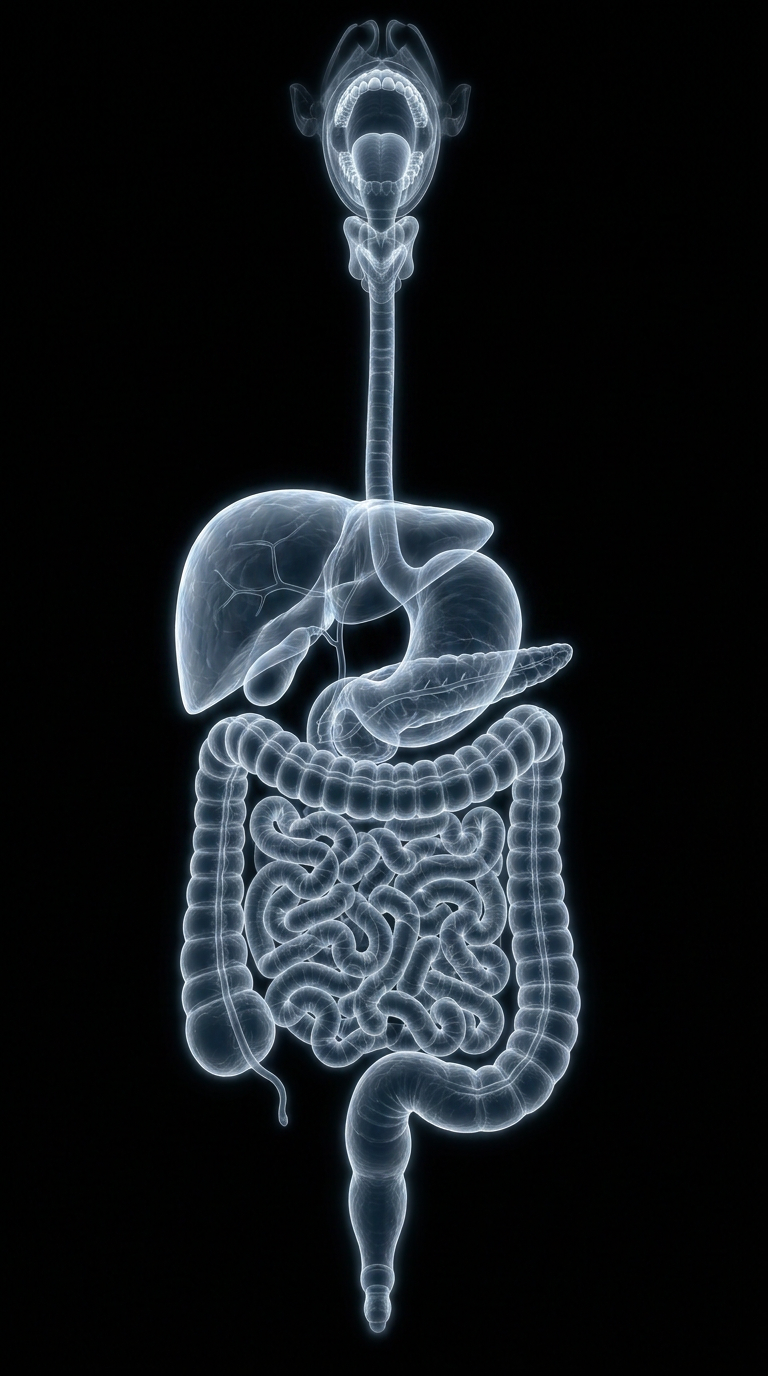
Esophagus
The muscular corridor from throat to stomach, and the cancers that arise in its lining.
Quick facts
~60,000
New India cases yearly (est.)
Top 5
Among the most common cancers in India
3x
Men more affected than women
Overview
- The esophagus is the muscular tube that carries food from the throat to the stomach.
- Esophageal cancer typically develops as one of two main types: squamous cell carcinoma (linked to smoking and alcohol) or adenocarcinoma (linked to chronic acid reflux and Barrett's esophagus, a condition where the esophageal lining changes due to long-term irritation).
- A diagnosis means abnormal cells are growing in the esophageal lining; because early esophageal cancer often causes few symptoms, it is sometimes found at a later stage, which is why risk-factor awareness and prompt evaluation of symptoms matter.
01Risk factors
- Chronic gastroesophageal reflux disease (GERD) and Barrett's esophagus
- Tobacco use and heavy alcohol consumption
- Obesity, particularly for adenocarcinoma
- Diets low in fruits and vegetables, or high in smoked/processed foods
- Older age (most cases diagnosed after 55)
02Signs & symptoms
- Difficulty or pain swallowing (food feeling "stuck")
- Unintentional weight loss
- Chest pain, pressure, or burning, especially with swallowing
- Worsening or long-standing heartburn/acid reflux
- Chronic cough or hoarseness
- Vomiting or regurgitating food
- Fatigue from anemia (low blood count)
03Screening & diagnosis
- Upper endoscopy (EGD) to examine the esophageal lining and biopsy suspicious tissue
- Barium swallow X-ray to outline the esophagus
- Endoscopic ultrasound to assess how deep a tumor extends
- Surveillance for people with confirmed Barrett's esophagus
04Treatment
- Endoscopic removal for very early, confined lesions
- Surgery (esophagectomy) to remove the affected portion
- Chemotherapy and radiation, often before surgery
- Targeted therapy and immunotherapy for advanced or specific molecular profiles
05Surgical procedures & operations
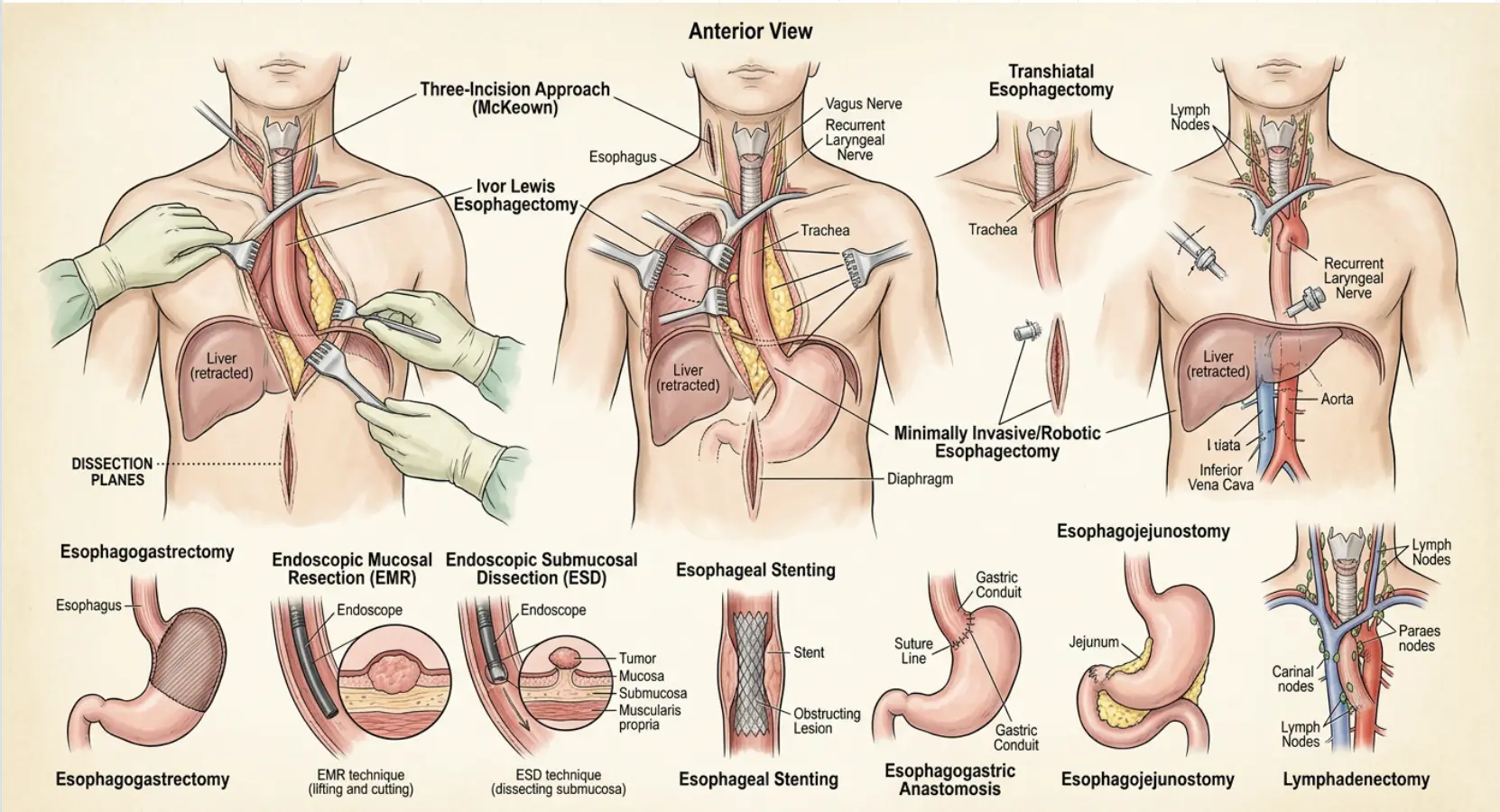
- Endoscopic Mucosal Resection (EMR), removes very early, superficial tumors through an endoscope, without external incisions
- Endoscopic Submucosal Dissection (ESD), removes larger superficial tumors endoscopically, layer by layer
- Transhiatal Esophagectomy, removes the esophagus through incisions in the neck and abdomen, avoiding the chest
- Transthoracic Esophagectomy (Ivor Lewis), removes the esophagus through incisions in the abdomen and chest
- McKeown (Three-Field) Esophagectomy, removes the esophagus through incisions in the neck, chest, and abdomen
- Minimally Invasive Esophagectomy (MIE), laparoscopic and/or thoracoscopic (or robotic-assisted) version of the above approaches
- Esophagogastrectomy, removal of part of the esophagus along with part of the stomach when a tumor spans the junction
- Gastric Pull-Up Reconstruction, the stomach is reshaped into a tube and pulled up to reconnect to the remaining esophagus after removal
- Colonic Interposition, a segment of colon is used to reconstruct the esophagus when the stomach isn't a suitable option
- Esophageal Stenting, placement of an expandable tube to keep the esophagus open; typically palliative rather than curative
- Feeding Jejunostomy or Gastrostomy Tube Placement, supportive procedure to allow feeding during treatment or recovery
06What you can do at home
- Manage chronic acid reflux (GERD) and discuss persistent heartburn with a doctor, since long-term reflux is a key risk factor
- Avoid tobacco and limit alcohol intake
- Maintain a healthy body weight, as obesity increases risk
- Eat a diet rich in fruits and vegetables and limit processed and very hot (temperature) foods and beverages
- Eat slowly and chew thoroughly; note any new difficulty swallowing
- Elevate the head of the bed and avoid eating close to bedtime if reflux is an issue
- Seek medical evaluation for swallowing difficulty or persistent reflux lasting more than a few weeks, especially if you have Barrett's esophagus, since it may warrant monitoring
Research at GutLiv
GutLiv funds early-detection programs for Barrett's esophagus surveillance and trials of minimally invasive endoscopic eradication therapy, catching the disease before it becomes invasive.